Skin Magic — P. Djèlí Clark

Skin Magic -- P. Djèlí ClarkYou can find this in the anthology, Griots: Sword and Soul.

I was hoping for more of the similar and i wasn’t disappointed.

Once again we’re thrown right into North-African/Middle-Eastern folk lore kind of stuff with Djèlí’s incredible writing that just keeps dragging you along without a pause.

Djèlí’s writing is so refreshing, and i’m so looking forward to reading many more of his stories in the future.

Next up in the Djèlí timeline is Ghost Marriage.

P. Djèlí Clark’s Page

#fantasy #pdjeliclark

Troika — Alastair Reynolds

Troika -- Alastair ReynoldsOriginally published in Godlike Machines, and also available in the collection, Beyond the Aquila Rift.

The story starts with an escapee from a mental hospital in Siberia desperately trying to reach the local town.

The escapee was one of three cosmonauts sent to investigate an alien vessel that had appeared in the solar system years before.

The story bounces back and forth between the escapee trying to reach someone in town and when he was a cosmonaut at the alien vessel.

Quite a good twist in the tail of this one as well.

Another good novella from Alastair, a master of short fiction as well as the super long stuff too.

Next up on Alastair’s timeline will be Sleepover.

Alastair’s Page

#scifi #alastairreynolds

Terminal World — Alastair Reynolds

Terminal World -- Alastair ReynoldsA rather strange mix of steampunk and sci-fi with a hint of fantasy thrown in.   All in all, a rather good mix.

This is another one of Alastair’s trilogy in a single novel book, so if you aren’t in for a long haul then don’t bother.   But if you don’t mind a thousand Kindle Loc points of reading to get through this’ll keep you going.

While i didn’t find it anything like the normal page turners that Alastair generally puts out, i did keep coming back to it twice a day for a little read and soon got through it.

So, while not the greatest thing that Alastair has ever written, and personally wishing he’d just stick to the sci-fi that he’s so brilliant at, it’s still a fairly good read.

Next book in Alastair’s timeline is Troika.

Alastair’s Page

#scifi #alastairreynolds

Inhibitor Phase — Alastair Reynolds

Inhibitor Phase -- Alastair ReynoldsIt had been a bit of a wait since Galactic North but now that Inhibitor Phase has arrived, was it worth the wait?

Well, ok, i’m gonna get my rant out of the way before i go any further.

To begin, we find ourselves on one of the few remaining human colonies that the Inhibitors haven’t got to, that of Sun Hollow.   We’re lead to believe that the people of Sun Hollow live inside a star scoured planet where resources are incredibly tight and the struggle to survive is always right on the edge.

Ok, that’s fair enough.

So why, oh why, oh why the fuck, does Alastair have to put sheep farming into this already over-stretched and under-resourced ecosystem?   This is the most imbecilic thing that is possible to write into this situation.   Where, for a start, do the sheep get their feed from?   Surely, if there are resources enough to keep a viable gene pool of sheep going just so these idiots can taste mutton every day then Sun Hollow must be a paradise to live with resources and space aplenty.

I put the question to anyone who disagrees with me: how many calories of plant foods does it take to make a calorie of mutton?

And as there is absolutely no nutritional need for Homo sapiens, or any other monkey/ape to eat dead animals, why would the people of Sun Hollow be throwing good plant food (that humans do need to eat) away like this?

Yes, Alastair, you screwed up royally on this one.

Anyway, rant over.

The rest of the book is good though, picking up after the events upon Hela that we left off in Absolution Gap, we get to meet Scorpio and Aura again with a new bunch of interesting characters thrown into the mix.

And best of all is that the ending certainly leaves things well and truly open for further books in the series: which i do look forward to as long as Alastair realises that there is no place for animal agriculture in the future of humanity because Homo sapiens have no nutritional needs that can be met by eating dead animals, and animal agriculture is the biggest contributor to environmental destruction on the planet Earth so it certainly won’t be part of any future space colonies that we set up, unless we want them to fail miserably.

Alastair’s Page

#scifi #alastairreynolds

A Blade to the Heart — Gaie Sebold

A Blade to the Heart -- Gaie SeboldAvailable in the anthology, Legends.

So far i’ve really enjoyed reading Gaie’s books but, sadly, i just feel this short fell a little short.

While i do think the redemption thing can be good fodder to build a story around, i just think in this case it’s all got a bit too rushed.   Probably would have been much better as a novella, at least.

But, ho hum, every favourite writer has to write at least one thing that just doesn’t work for the fangirl/fanboy reader: does anyone remember The Girl in Red?

Gaie’s Page

#fantasy #gaiesebold

Pan’s Labyrinth — Guillermo del Toro & Cornelia Funke

Pan's Labyrinth -- Guillermo del Toro & Cornelia FunkeThis is one super good, dark fantasy/fairy-tale.

Set in 1944 at the end of the Spanish Civil War, with Franco’s troops continuing their brutal repression of anyone and anything that stood in their way.   It gets rather violent, brutal and nasty, and caught in amongst all of this is our protagonist, Ofelia, a young girl who has grown up with the horrors of war all around her.

This is not a book for children, or for the faint of heart looking for a nice fantasy/fairy-tale read, but it’s certainly worth a read if you can handle a fair bit of brutality.

Guillermo’s Page Cornelia’s Page

#guillermodeltoro #corneliafunke

My Twenty Years of Racing — Juan Manuel Fangio

I found this while doing my thrice weekly tour of my town’s charity shops.   As a life long Formula 1 fan, i simply couldn’t resist.   Especially since it was in the 50 pence box.

So yes, it’s a real paper and card book, made out of trees and stuff, i actually own one, a first edition hardback and everything!!!   Well, if you’re going to betray your life long vows to your Kindle then at least make it a quality book.

All that aside, what you really want to know is what the actual writing is like, isn’t it?

Oh yeah, it’s amazing.   Obviously, at 57 years old, i wasn’t following Formula 1 when Fangio was driving, up to this book all i really knew about him was that he was a 5 times Formula 1 world champion from the 1950’s, who people like Stirling Moss and Jackie Stewart would always proclaim as the GOAT, whenever the topic of Formula 1’s GOAT turned up.

Oh yes, this review wouldn’t be complete without the GOAT thing coming into it.

The current debate always seems to be between Michael Schumacher and Lewis Hamilton, simply because of the 7 world championships each, but so many of the younger crowd following Formula 1 simply fail to put any of it into context.

When reading this autobiography one realises that modern Formula 1 drivers can never be compared to those of the early years.   Modern Formula 1 drivers are never seen getting on their hands and knees repairing the car between sessions, or at the side of the road during an open road race like the Mille Miglia (now not a race any more).   Modern Formula 1 drivers drive on sanitised, super safe, almost billiard table smooth, tracks; they have teams around them for their every need: they don’t even carry their own bags any more for fear of tiring their arms out unnecessarily.

When one goes back to Fangio’s early years, that of a farm machinery mechanic in Balcarce, Argentina, who would race in the most treacherous conditions with old cars bought with scraped up savings and donations that he would have to engineer himself into racing machines, one realises the difference between the past and the present.   Those drivers of the early years of motor racing had to face things that modern drivers would simply refuse to even contemplate doing.   Those early years were utterly insane in comparison to modern motor racing.

But more than anything else, this book is so well written, with Fangio telling everything straight from his own experiences of how it truly felt and how those young years of the Formula 1 World Championship truly were: from the highs of those world title wins all the way down to the absolute lowest of the lows in the history of motor racing as he was right behind Pierre Levegh’s car at Le Mans 1955 when Levegh hit Lance Macklin’s car.

The book is also full of the most wonderful photos of those cars and races, along with interludes written by Fangio’s close friend and manager, Marcello Giambertone, telling the reader what it was like looking in at Fangio’s career.

And right at the end of the book the reader will find a full list of all the cars Fangio raced and of all Fangio’s races, and if anyone reading this book is truly honest, then anyone reading this book would have no hesitation as to proclaiming Juan Manuel Fangio the Greatest Of All Time when it comes to driving and especially Formula 1.

So before you join in on any Formula 1 GOAT arguments ever again, do get a copy of this book and read it first.

Juan’s Page

#autobiography #formula1 #juanmanuelfangio

Walls — Gaie Sebold

Walls -- Gaie SeboldAvailable to read in the anthology, X7.

Wow, that was a weird trip.   This short story starts really strangely, and gets even stranger, as our protagonist, Chrys, who suffers from agoraphobia and can’t go out, gets worse and worse to the point of having what seems to be a total psychotic melt down.

And then everything comes crashing down, and boom!   What an ending.

Ever more wonderful writing and story telling from Gaie, a master of the writing craft.   If you haven’t yet read any of Gaie’s writing then i really suggest you get started, it’s real good fantasy for grown ups who love real good fantasy.

Gaie’s Page

#fantasy #gaiesebold

Ghost in the Shell — James Swallow

Ghost in the Shell -- James SwallowBasically, it’s just the film in writing.   Which, if you’re just wanting to read what happens in the film, then great, but personally i feel that this is just totally lazy on the part of the writer: or maybe this is all they were told to do by the rights holder???
The great thing about books, as opposed to film, is that you don’t have to pay for the sets, the extra cameras, the costumes, etc..   In a book the writer is simply limited by their own imagination and language skills, whereas in a film the director/writers are totally and absolutely constrained by finite resources such as finances, but also logistics, cgi limitations, the human elements of everyone involved (remember the pandemic and the disruption that caused to films and tv shows?) and many other things besides.   So to sit down and write a novel based upon a film, one would think a really good writer would have a fucking field day with it, but, with Ghost in the Shell, they didn’t.

Like is say, maybe this was the brief, and when someone throws a bag of money in the direction of writers and tells them what they want writing i would imagine they’ll get plenty of writers clamouring to take on such an easy task as this “novelisation” must have been.

At less than 2300 Kindle Loc points you’re pushing it to label this as a novel anyway.   At this length you’re seriously riding the boundaries between novella and novel.

I suppose they didn’t want to upset the film fans who only have attention spans of two hours.

So yeah, sadly, a total let down.   There could have been so much more background and detail that could have really added to the story.   A seriously wasted opportunity.

James’ Page

#scifi #cyberpunk #jamesswallow

The Slow Sad Suicide of Rohan Wijeratne — Yudhanjaya Wijeratne

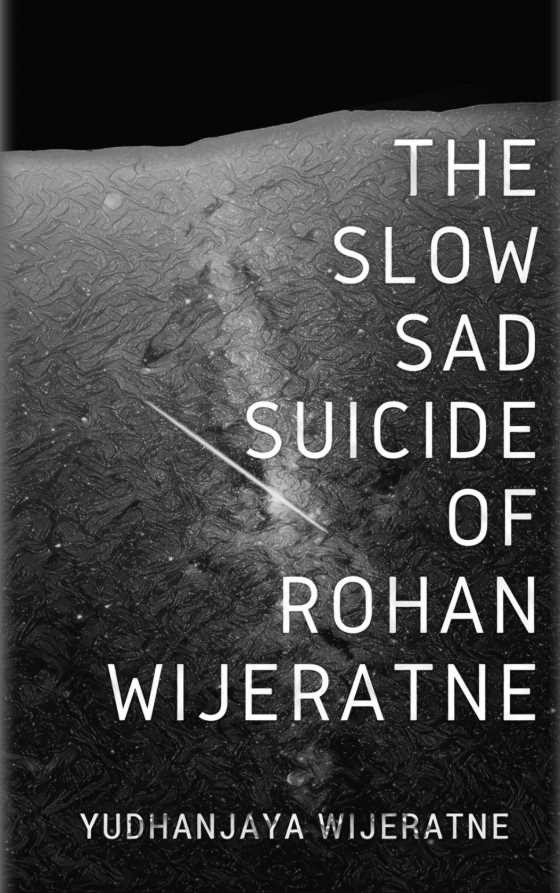
The Slow Sad Suicide of Rohan Wijeratne -- Yudhanjaya WijeratneI came across Yudhanjaya’s writing in the anthology 2054, where i found his very enjoyable Deep Ocean Blues.   So having really enjoyed that novella i thought i’d go and have a hunt around and see what else Yudhanjaya has written.

The Slow Sad Suicide of Rohan Wijeratne is, i believe, Yudhanjaya’s first book, albeit just a short story.   It tells the tale of a poor little rich kid who has never had to work for anything and has essentially squandered his life.   He’s now so fed up with his pointless rich existence he just spends his time trying to kill himself.   But he’s so rich his parents had him filled with nanites that heal his every wound and illness, preventing him from ending his own life, no matter how hard he tries.

Then, one day, while driving a tuk tuk, Rohan hears about a space program wanting volunteers to be shot straight into a black hole: even the nanites won’t save him this time.

All in all, this is a really good short story, well written, but it does get lost here and there in the terminology and theories of black holes.   But Rohan is also completely lost with all the science of it, his nanites stopped working after 30 years in cryo-sleep to get to the black hole and he’s lost a lot of his intelligence.   Essentially, being baffled by all the science nonsense puts you right in the mind of Rohan as he plummets into the abyss.   Have fun!

Yudhanjaya’s next book is Numbercaste, which i shall get around to reading at some point in the future.

Yudhanjaya’s Page

#scifi #yudhanjayawijeratne